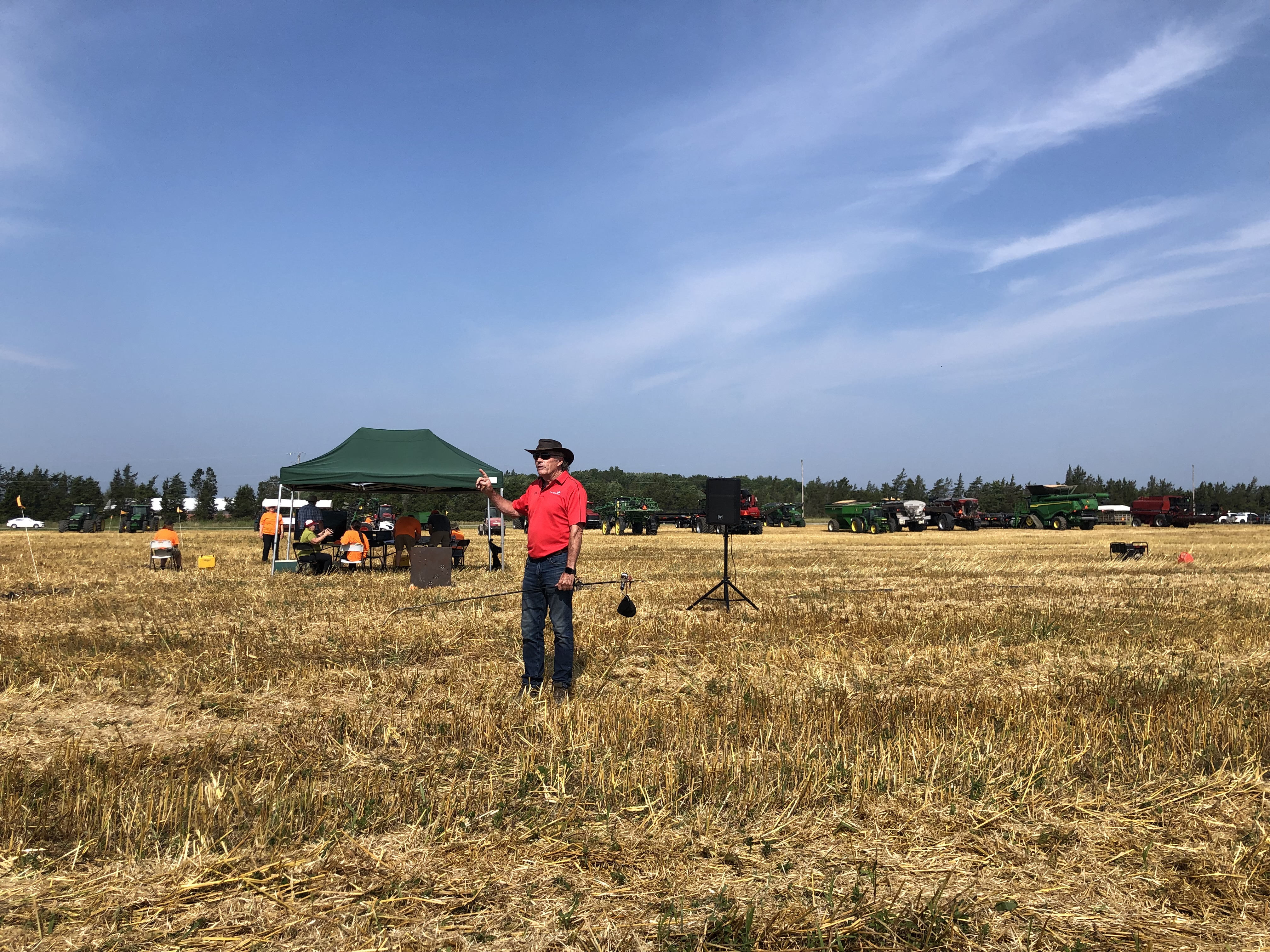
Sometimes in Ontario we do things right. Today I attended a “compaction day” near Rutherford Ontario where the St Clair Soil and Crop Improvement Association with various sponsors put on demonstrations regarding how compaction impacts are crop yields. The day was full of demonstrations regarding how farm machinery can impact compaction on various soils using instruments that measure compaction in both wet and dry conditions. For your loyal scribe solidly ensconced in his agricultural economic background, it’s always good to get down in the dirt. Compaction certainly has an agricultural economic cost which we all should consider.
It is a difficult problem, especially when you farm on heavy soils. For instance, it is always pertinent to plant when the ground is fit. In other words, you don’t plant on wet ground and in fact you try not to do too much farming in wet conditions. Simply put, when that happens you have too much compaction which is a long term agricultural economic cost that will eventually catch up with you.
I remember a few years ago I planted corn in a field with a particularly heavy clay soil. At the end of the day, I had one of my highest yields ever on that field. However, I took the corn off in particularly wet conditions it was just one of those years. The following year my soybeans weren’t very good at all. It is a cost that follows you around. Kudos to the people in Rutherford Ontario today who did the measurements and showed us the costs and mitigation factors up front.
Interestingly enough, the topic of the day wasn’t all about compaction. I had several colleagues come up to me and lament the current conditions of the crop price markets and how low prices had gotten. Of course, I tried to answer my farmer colleagues as good as I could, but you know, it’s just been a long story this year. We had contract lows in corn and wheat recently and the market could sure use some fresh news other than record crops.
We will get that on August 12th when the USDA releases their latest WASDE report. I don’t need to tell you that many private forecasters have been telling us that the US corn yield is going to be even higher than the 181 bushels per acre predicted by the USDA in their last report. I have heard up to 189 bushels per acre, it just seems with good crop weather the crop yield expectations south of the border are going crazy. There must not have been too much compacted soil this past spring.
The corn yield in Ontario last year was over 200 bushels per acre which is incredibly impressive. However, it was pretty obvious by much of the talk at the compaction day in Rutherford that the rest of Ontario is suffering through a pretty debilitating drought. Rain is needed now for many crops in the east and central parts of Ontario.
Of course, that reality might just rub salt in the wounds Ontario farmers, who might not have the crop they would like and have lower prices to boot. I had a discussion at the “compaction day” with the government official and he was lamenting the lack of federal participation in Ontario’s Risk Management program. He rightly felt that this would surely help producers on a year like this when prices have got so low.
At times like this we’re often looking for clues into the future with regard to our crop prices and we might get that on August 12th when the WASDE estimates are announced. Keep in mind, in the last 10 years the USDA has decreased yield four times from July to August. On the contrary in six of those years they have increased yield. Of course, there is no news about a black swan just around the corner.
There will be a change in all these lower trends but of course cranking down grain supply is always a difficult thing. It is a vicious cycle in our agricultural production, that we try even harder next year to make things better producing even more. Generally, overtime, that always leads to lower prices. We depend on increased productivity to sell more bushels at the prices in front of us. At the compaction day today in Rutherford Ontario, it was pretty obvious that many farmers we’re increasingly concerned about this trend and how much lower prices might go. Thankfully we have the Canadian dollar trading in the 72 cent US range to make things tenable.
Going forward we’re hoping for better things. It was interesting today during the compaction demonstration as we were told one factor that mitigates compaction is our increased productivity through genetics. In other words, our new genetics are so good that they’re overcoming some of the costs of our soil compaction. Of course, getting both things right is the goal.
The challenge for eastern Canadian grain farmers as we sit going into the next WASDE report is to weigh the optimism of these remarkable genetic advancements against the reality of market headwinds and weather uncertainty. Soil compaction may be a silent yield robber, but in 2025 it shares the stage with low grain prices, unpredictable rain, and the constant pull to produce more. As we move toward harvest, daily market intelligence will be key, because there will be many grain marketing opportunities ahead for those ready to act when the numbers change. In the meantime, whether it’s in the field with a shovel or in front of a screen watching futures, keeping both agronomy and agricultural economics in balance will remain our best defence.