It is an uneven time. I paid $163 the other day to fill up my Ford F-150 pickup. That’s a world record for me. I think everybody is setting their own personal world record when it comes to filling up at the pumps. Needless to say, it’s going to change the behaviour of many a motorist.
Our fuel price fixation in North America is a bit of a vice. I never smoked so I don’t know what quitting smoking is like. However, cheap gas gave everybody an opportunity to waste it and waste it we did. It shouldn’t be put all on the shoulders of individual consumers. Our North American automakers could develop better technologies to get us over the hump. However with the lure of a cheap buck out there, giant SUVs and other gas-guzzlers came onto the market. A willing public ate them up.
In my own case, I wanted that F-150 like a hole in the head. Most of you know the story. I drove my Dodge pickup with a 228 six-cylinder engine for 23 years. When it literally fell apart with me in it, I thought I’d better do something. With my day job requiring a truck, I was between a rock and a hard place. So now I have an eight-cylinder engine, which I don’t need in a truck with air-conditioning. Those features I didn’t want but in 2007 that’s about as bare bones as I could get.
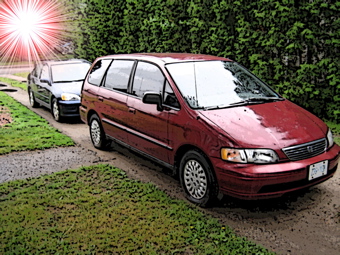
What I’m getting at here is needs versus wants. In my own case I’ve got that gas guzzling truck, but my other two vehicles are 4 cylinder vehicles. The Honda Civic and Honda Odyssey are particularly good on gas. However, my love affair with my 1995 Honda Odyssey has a long history. It also serves, as an example of what I think is wrong with North American car psyche. Let me tell you the story.
As you’ve probably surmised, I don’t care for cars. I don’t get it. To me transportation is getting for A to B as cheap as possible. However, my family expanded way back in 1995 and I needed a van to carry all of that little baby stuff. I bit the bullet for a while, driving my Honda Accord, but eventually a purchase decision had to be made. I chose a 1995 Odyssey and 487,000 kilometres later, its still doing a bang up job.
The problem came several years later. My family and I put a lot of kilometers on the car. So we either had to get another car or drive the Odyssey into the ground. However, Honda chose to ditch the 1995 Odyssey design, going for a bigger wider, longer, bigger engine Honda Van, the new Odyssey. I didn’t like it because it was too big and I deemed is much less efficient. So I decided to keep the old Odyssey and buy a Honda Civic. I’d drive the Civic and by default the Odyssey would get less kilometers on it, which would extend its service to my family. It seemed to be the plan for me. I’d maintain fuel efficiency and avoid buying one of those “big North American vans.”
Fast-forward to 2003 and I find myself in Singapore. I’m walking down the street in an effort to get an American hamburger and a brand new Honda Odyssey that looked like a newer version of my 1995 van passes me. I took several double takes. A few days later I was in Bangladesh and the same thing happened. I’m thinking what’s up? Why are “these people in Asia” driving brand new fuel-efficient 4 cylinder Honda Odyssey vans, which I no longer can purchase? Needless to say on my return to Canada I found out Honda is still producing and selling these vans in Asia. However, being situated here in North America, I no longer can have the opportunity to buy it. It seemed Honda was intent on cashing in on North American’s insatiable demand for bigger, more gas guzzling vans.
That was a corporate decision, which essentially made Honda a lot of money, but at the end of the day contributed to North Americans wasting energy. We simply don’t need these big, big vehicles that guzzle gas.
It takes me back to the day when my good friend and East West sidekick Dr. A.K. Enamul Haque was telling me about his new car. He told me both his cars were powered by natural gas, an abundant resource in Bangladesh. Then he said, why aren’t yours? Needless to say, I was a bit taken aback. I really didn’t know why, in fact, I didn’t have a very good reason.
However, in retrospect it was obvious. My cars aren’t powered by natural gas or some other source because in North America we’ve never had enough of an incentive to do anything different. Our collective mentality has been big vehicles powered by gas regardless of how much. It’s led to the $163 fill up and it makes no sense at all. Someday, somewhere, as a society, we need to come to grips with that reality.