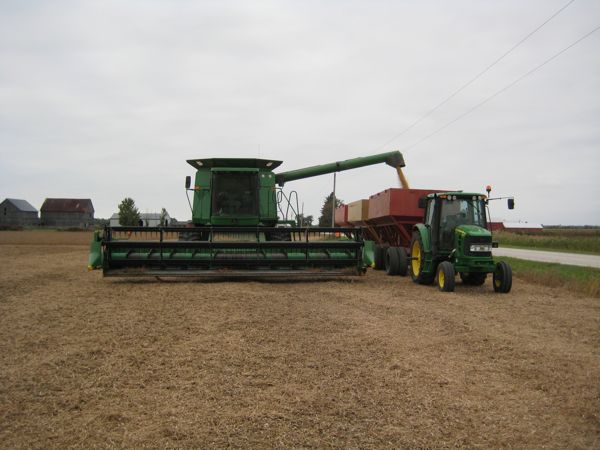
I wasn’t that happy with my soybean crop last year. I ended up with an average yield, and of course my corn yields were off the chart. You might say that soybeans are a bit like sheep; increasingly all they are is trouble. At one time in my career you planted them in a cloud of dust, cultivated them twice and counted on 50 bu/acre come October. Now, we watch as aphids attack along with the bean leaf beetle while corn passes them like they are not even growing.
Welcome to my soybean-planning horizon for 2009. I’m going to be planting a few more seeds/acre this year. That has more to do with my soil type than any other agronomic advantage. Most of my land you can’t tell while plowing whether you’ve hit the road yet. Now, I’m just kidding, sort of, but my heavy clay land like lots of seeds per acre. Harkening back to Forrest Gump, in my soybean fields, “you never know what’s going to come out of the ground.”
I’m facing my own personal soybean yield wall. I had my record yield of 58-bushels/acre way back in 1998. Since then I’ve done OK, but in today’s agricultural economy, that’s like saying I like climbing slippery slopes. Simply put soybean yields have become everybody’s proverbial challenge.
So much so that the Ontario Soybean Growers (OSG) have actually launched the 2009 “Soybean Yield Challenge” after a successful 2008 event. According to OSG, the nine winners of the 2008 OSG Soybean Yield Competition were Dan Shantz of Petersburg with the top yield for Zone 1 (2700 CHU & under) at 69.1 bu/acre. John Denys of Parkhill won in Zone 2 (2725 CHU to 3000 CHU) with 70.22 bu/acre. And Casey Klaver of Seaforth won in Zone 3 (3025 CHU & above) with 72.1 bu/acre. Ah hem, for those of you who need to know my yield in 2008 was forty something and I’m in Zone 3. I guess there is no need for me to enter the 2009 soybean yield challenge. The last time I was in a yield challenge it was corn, I got 93 bushels/acre, the guy who won got 243 bu/acre. Needless to say, it never did rain on my farm. That’s my story and I’m sticking to it.
The March 11th USDA report was bullish for soybeans. Ending stocks dropped over 6% from February with ending stocks down to 185 million bushels from 210 million bushels in February. Soybean exports have been extremely healthy out of the United States, however it’s been tempered somewhat by weak domestic soybean meal demand and poor crush margins for soybean processors. The market has worked its way up over the $9 futures mark lately, a long way from those highs last July. Still for Canadian growers the magic $10 /bushel number is always a barometer for profit. With our basis values nearing $2/bushel, the $11/bushel mark is in site.
It surely is true we’ve had an inverted soybean market with nearby futures outstripping outward months. For instance new crop bids in Ontario are currently about $1.50 below old crop bids. In other words, there are some bullish fundamentals happening within the market with buyers in need of soybeans. In our current scenario of a futures market affected adversely by “outside markets”, the true price demand relationship has yet to come true. However, the inversion of futures has made up a lot of that.
So how many soybeans are going to be grown in 2009 in the US and in Canada? On March 31st we’ll find out what the USDA thinks. So far they are musing about 77 million acres, an increase from this past year. However, in Ontario, I think the “reduction in corn acres” and subsequent increase in soybean acres might be muted because of the production problems we’re facing in Ontario fields. Simply put, many of us might bypass the soybean aphid, bean leaf beetle and that yield wall, take a chance on corn and see where that gets us next fall.
Our bankers might have a say in that too. The sticker shock from planting an acre of corn this year might be just too much for many of our bankers to take. Some of you might be like me and go to the bin, take the beans out and clean them yourself, plant them and see what happens. At this point in March, its all still a theory. However, it will all play out in the next six weeks.
Still, “soybeans” have a real problem. The yield wall I’m experiencing isn’t uncommon, everybody’s got it. This past winter it was re-iterated at almost every meeting I attended. In fact when I put my “Market Trend” analyst hat on for the Ontario Corn Producers the “soybean yield wall” has almost become institutionalized in predicting prospective acreage and yield. Looking ahead, even with some of the new generation two biotechnologies coming down the pipe, I don’t see it changing much.
However, the soybean price might change a lot. The world is not growing tired of the soybean. So for growers who find a magic soybean formula, they are poised to benefit. Eventually that yield barrier will come falling down.